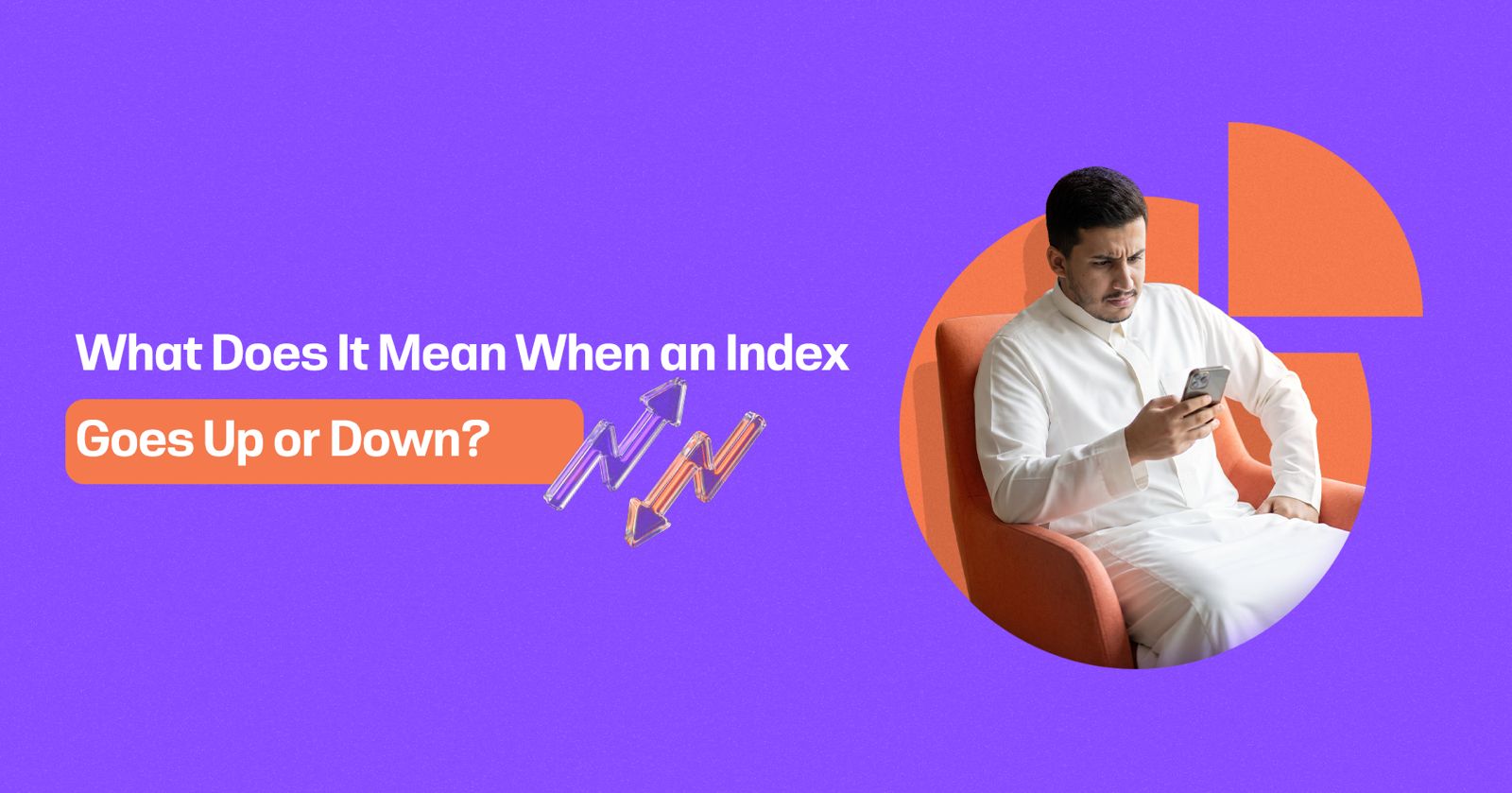
Salem recently started getting interested in investing. Every day, he opens the financial news and hears the same phrases: “The index rose today” or “The index closed lower.”
The problem? Salem is not exactly sure what an index means. Is it a stock? Is it a company? Is it the whole market? And if the index goes up, does that mean every stock made gains? Let’s simplify it.
What Is an Index?
Imagine you walk into a large shopping mall with many stores, all operating in the same field. Instead of walking into every single store to check its sales and compare performance, there is a screen at the entrance that tells you whether business today is strong, average, or weak.
Think of it like customer traffic in a store: the more people visit a certain store, the higher the demand appears to be. If fewer people visit, demand is lower.
A market index works similarly. It measures the performance of a group of stocks and gives you a general idea of the direction of the market or a specific sector.
So instead of following every stock individually, the index gives you a quick reading of the bigger picture.
Does the Index Represent Every Stock?
No, and this is an important point.
If the index rises, it does not necessarily mean that every stock in the market has gone up. And if it falls, it does not mean that every company performed poorly.
An index measures a selected group of stocks, and some companies may have a larger impact on the index than others, especially if the index is weighted by market capitalization.
In simpler terms:
Larger companies, such as Saudi Aramco, stc, Al Rajhi Bank, and Saudi National Bank, can influence the index more than smaller companies.
Why Should Investors Care About the Index?
Let’s go back to Salem.
Salem has a small investment portfolio. After one month, he notices that his portfolio is up by 3%.
He gets excited and almost starts planning a dinner to celebrate. But then comes the more important question:
Is that actually a good performance?
This is where the index comes in.
If the market rose by 10% and Salem’s portfolio rose by 3%, then his portfolio underperformed the market. But if the market rose by 1% and his portfolio rose by 3%, then his performance looks much better.
The index helps investors evaluate performance against a clear reference point instead of relying on feelings.
The Index Level Is Not Everything
When we hear that the TASI index reached 12,000 points, this number represents the level of the index at that moment. But by itself, it is not enough to judge market performance.
What matters more is reading that number in context.
A market index gives you a general picture, or a kind of compass, but it does not mean that all stocks moved up or down in the same way.
Think of it like a weather app. It may show you a certain temperature, but how it actually feels can be different because of factors like wind and humidity.
That’s why a better reading comes from looking at the percentage change, the time period, sector movements, and the companies that had the biggest impact, not just the index level on its own.
What Moves the Index?
An index does not move for no reason. Its movement is affected by the performance of the companies listed in the main market, especially the companies with the largest weights in the index.
That is why the performance of a few major companies can sometimes have a clear impact on the overall market direction.
Here, it is important to separate two things:
The index gives you the general direction of the market, but you still need to look at the details behind that movement.
If the index rises, it may indicate that the market was generally positive. But to understand the picture more accurately, you need to look at sectors, the most influential companies, trading value, and trading volume.
This way, the index becomes a starting point for understanding market direction, not a final judgment on every stock or sector.
The Index Is a Compass, Not a Decision
At the end of the day, a market index does not tell you to buy or sell. It gives you a general direction and helps you understand the market’s condition and evaluate your portfolio’s performance.
Use it as a compass. But your investment decision needs a wider understanding:
What is your goal?
How long do you plan to invest?
What is your risk tolerance?
How diversified is your portfolio?