Hi, I’m Thamer. For a while now, I’ve wanted to get into investing, but every time I was about to start, I’d hesitate and ask myself: where do I even begin, and how?
I used to check the market every now and then, and I had a particular company in mind. Every month I’d tell myself, “As soon as the price drops, I’ll buy.” Then the price would drop, and I’d think, “Maybe it’ll drop even more, so I’d better wait.” A while later, I’d check again, find it had gone up, and tell myself, “That’s it, I missed my chance.”
One day, I was talking about this with a colleague, and he asked me: “Why don’t you read about dollar-cost averaging (DCA)?“
The term was new to me, so I went and looked it up, and found that the idea was exactly the approach I’d needed all along: instead of trying to pick the best day to buy, I invest a fixed amount on a regular schedule.
Here are the most important things I learned about this strategy, and how I started to understand it and make it part of my plan.
What Is Dollar-Cost Averaging (DCA)?
After doing some research, I learned that:
DCA stands for Dollar-Cost Averaging. It’s also known as the average cost strategy, or investing a fixed amount on a regular basis.
The idea is that you set a fixed amount and invest it in the same asset at regular intervals, such as every week or every month, regardless of whether the price goes up or down.
So instead of waiting for a price I think is right, I set the amount and a purchase date, and I stick to them.
If the price is low, that amount buys more units. If it’s high, it buys fewer.
And as I keep repeating this, I build up an average purchase price across different periods, instead of tying my whole investment to the price on a single day.
How Does Dollar-Cost Averaging Work?
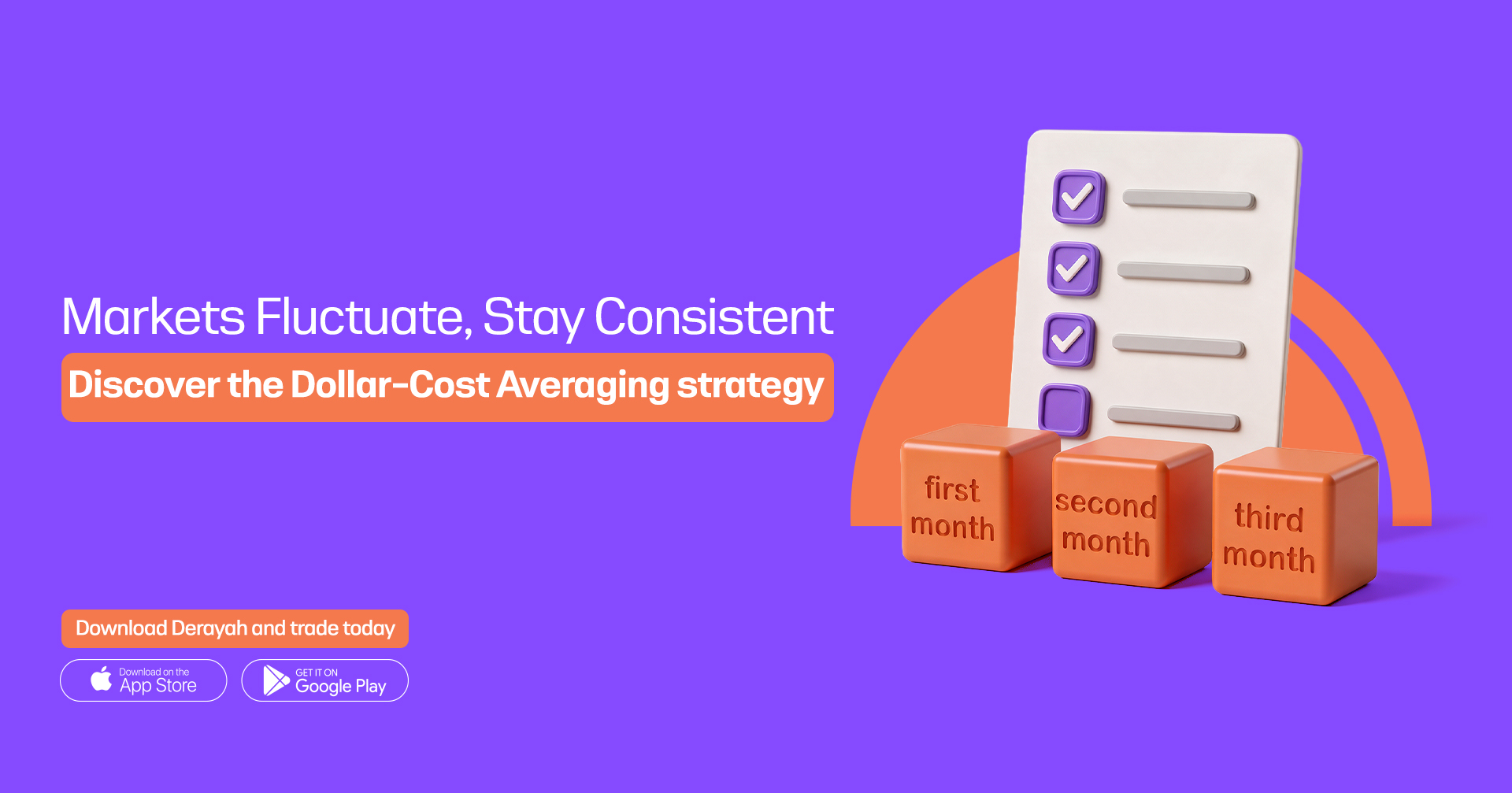
To understand the strategy more clearly, I imagined investing SAR 1,000 every month in a particular asset.
In the first month, the price per unit was SAR 100, so I bought 10 units.
In the second month, the price dropped to SAR 50, so the same amount bought 20 units.
In the third month, the price rose to SAR 125, so I bought 8 units.
Over three months, I invested SAR 3,000 and bought 38 units, at an average cost of about SAR 78.95 per unit.
That’s when I understood why it’s called cost averaging.
The amount I invested never changed, but the number of units changed with the price.
I bought more units when the price fell and fewer when it rose, so my purchases ended up spread across several price levels
What Are the Benefits of Dollar-Cost Averaging?
The biggest benefit I noticed is that it spreads your purchases across different times and prices, instead of tying your whole amount to a single transaction.
With a fixed amount, you buy more units when the price falls and fewer when it rises.
This helps you build an average cost over time, and makes your plan less dependent on trying to pick the perfect moment to buy.
Before I learned about DCA, I was focused on just one question: Is this the right time to buy?
Afterwards, my questions changed:
How much can I invest on a regular basis? What timeframe suits my goal? And is the asset I’ve chosen right for me in the first place?
DCA doesn’t predict where the market will go next, but it organizes how you enter it and makes your plan less dependent on a single decision at a single point in time.
The second thing I noticed is that having a set amount and a set purchase date made me less affected by market movements.
A price drop no longer made me pause my plan out of fear, and a price rise no longer pushed me to increase my amount out of excitement.
My decisions became tied to my plan, rather than to one day’s movement.
Is Dollar-Cost Averaging Right for Every Situation?
I found that DCA is better suited to someone with a regular income and a long-term goal, who wants investing to become a steady part of their plan.
It may also suit someone who already has a lump sum but prefers to spread it across several purchases instead of investing it all at one price.
Choosing between investing gradually and investing the full amount at once depends on your goal, your timeframe, the nature of the asset, and how well you can handle market fluctuations.
Conclusion
The idea behind dollar-cost averaging is simple: you set a fixed amount and invest it in the same asset at regular intervals.
This way, you buy more when the price is low and less when it’s high, and your purchases are spread across several price levels.
But the plan’s success still depends on choosing a suitable asset, setting a clear timeframe, and reviewing it over time.
For me, the most important result was that I stopped searching for the best day to buy, and started building an investing approach I can actually stick with.
Support & Contact
For inquiries or assistance, please reach out through Derayah’s official channels:
Phone: 920024433
Email: support@derayah.com
X (Twitter): @Derayah